
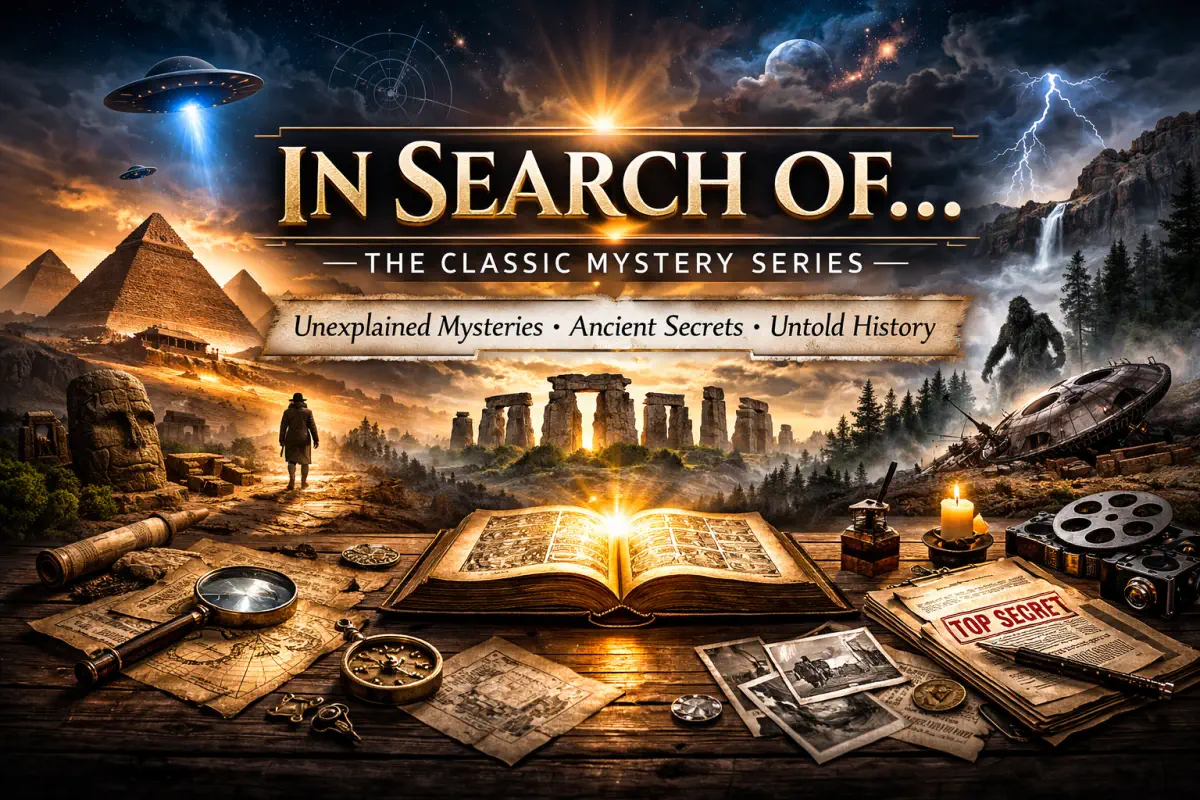
Before In Search Of… became a weekly series, there was a television special that helped shape its direction.
In the mid-1970s, audiences were already becoming fascinated with ancient astronauts, unexplained artifacts, and the possibility that human history was not as straightforward as textbooks suggested. That curiosity was amplified by The Outer Space Connection, a documentary-style special that explored whether extraterrestrial intelligence may have influenced early civilization.
The tone was serious. The narration was deliberate. The speculation was bold.
That special would become the conceptual stepping stone to what soon followed — a full investigative television series dedicated to the unexplained.
The Outer Space Connection (1975)
The Alan Landsburg Production That Set the Stage
Produced by Alan Landsburg and narrated by Rod Serling, The Outer Space Connection examined ancient monuments, religious symbolism, and technological mysteries through the lens of extraterrestrial influence.
The special aired before the launch of In Search of… and helped define the serious, investigative tone that would later characterize the show.
Some of its footage would also appear in other Landsburg–Serling collaborations. What makes this version particularly notable is that it has been digitally remastered from a rare VHS source — preserving a piece of speculative television history from a time when these ideas were entering mainstream conversation. Below is the full documentary:
The Series That Followed: In Search Of… (1977–1982)
When In Search Of… officially premiered in 1977, it expanded the mystery format into a weekly investigative series. Hosted by Leonard Nimoy — widely known for his role in Star Trek — the show carried a calm authority that gave weight to even its most speculative subjects.
From UFO sightings and cryptids to historical conspiracies and lost civilizations, the series approached each topic with structured curiosity rather than sensational conclusions.
At a time before the internet, before instant fact-checking, and before modern digital forensics, these mysteries felt larger — and more open.
The Cultural Climate of the Late 1970s
The late 1970s were marked by Cold War tension, government secrecy, and rising public skepticism. UFO sightings were national headlines. Alternative history books were climbing bestseller lists.
There was no algorithm amplifying outrage. Mystery unfolded at television pace — once a week.
In Search Of… reflected that moment in history perfectly.
Five Standout Episodes from the Original In Search of Series
The playlist linked in this post contains the full run from 1977–1982. Instead of summarizing everything at once, here are five episodes that best represent what made In Search of… culturally influential — and why they still hold interest decades later.
UFOs
Few subjects defined the late 1970s more than unidentified flying objects. When this episode aired, UFO reports were dominating headlines. Civilian sightings, military radar contacts, and speculation about government secrecy were explored with measured seriousness rather than dramatic certainty.
At the time, investigations relied heavily on eyewitness testimony and relatively limited radar technology. The episode presented interviews, examined available evidence, and avoided forcing a conclusion — allowing viewers to sit with the uncertainty.
Nearly fifty years later, the terminology has shifted to UAP, official investigations are more transparent, and advanced sensor systems have replaced much of the guesswork. Yet the core question remains unchanged: are these misunderstood natural phenomena, classified technology, or something beyond current explanation?
What makes this installment enduring is not what it proves, but how calmly it presents the unknown.
The Bermuda Triangle
This episode explores disappearances in the Atlantic region long associated with unexplained vanishings of ships and aircraft. Through interviews and reenactments, it examines reported magnetic anomalies, sudden weather shifts, mysterious radio silence, and navigational failures that fueled the legend.
While modern research attributes most incidents to natural weather systems, human error, or mechanical malfunction, the mystique persists. The episode illustrates how patterns — especially when filtered through media attention — can quickly evolve into global folklore.
Rather than declaring the Triangle supernatural, the program presents the mystery as a case study in how uncertainty shapes belief.
Bigfoot
Eyewitness Accounts and the Edge of Belief
From footprint casts to eyewitness film footage, this episode explores whether a large, undiscovered primate could exist in North America. Interviews with researchers attempting to validate sightings are balanced by skeptical perspectives demanding physical, biological proof.
No definitive evidence is presented — and that unresolved tension is precisely what keeps the legend alive. Nearly fifty years later, reported sightings continue, yet verified scientific confirmation remains absent.
The episode captures the delicate balance between belief and the scientific requirement for measurable, repeatable evidence.
The Lost Continent of Atlantis
Myth, Memory, or Misinterpreted History?
Drawing from Plato’s writings, classical texts, and archaeological speculation, this episode investigates whether Atlantis could have been inspired by a real ancient catastrophe. The program explores geological theories, submerged ruins, and flood narratives that may have shaped the legend over time.
Modern historians largely interpret Atlantis as allegory rather than documented history. Yet discoveries of ancient coastal settlements and evidence of catastrophic flooding continue to fuel discussion.
The episode avoids firm conclusions and instead illustrates how stories can evolve — shifting from philosophical narrative to enduring mystery across centuries.
Dead Sea Scrolls
Ancient Texts and Hidden History
This episode explores the discovery of the Dead Sea Scrolls and the profound historical and religious implications surrounding them. Found in caves near the Dead Sea in the late 1940s, the scrolls included some of the oldest known manuscripts of biblical texts ever uncovered.
The program examines questions that emerged at the time: Why were the scrolls hidden? Who preserved them? And did their contents challenge established historical or theological narratives?
While modern scholarship has extensively analyzed and translated the scrolls, confirming their importance to early Jewish history and biblical studies, debate once surrounded access, interpretation, and institutional control. The episode captures that period of uncertainty — when fragments of ancient parchment sparked global curiosity and speculation.
Unlike some of the more speculative installments of the series, this one centers on tangible archaeological discovery — yet still leaves room for the larger mystery of what history forgets and later rediscovers.
Other Notable Episodes Worth Watching
While the five featured above highlight some of the strongest themes from In Search of…, the full run between 1977 and 1982 covered a wide range of subjects that are still discussed today.
Some additional standout episodes include:
- A Call From Space: Examines mysterious radio signals and whether any could represent extraterrestrial communication rather than natural cosmic noise
- Pyramid Secrets: Explores the engineering precision of the Egyptian pyramids and debates over how such massive structures were constructed.
- The Secrets of Life: Looks at DNA, evolution, and unanswered questions about how life began and continues to develop.
- Immortality: Investigates humanity’s quest to defeat aging, from ancient legends to modern scientific research.
- Hypnosis: Explores how hypnosis works, its medical uses, and controversial claims involving memory and altered states.
- The Coming of Age: Examines rites of passage and how different cultures mark the transition from youth to adulthood.
- Cloning: Discusses the science and ethics of cloning, including early breakthroughs and future implications.
- The Siberian Fireball – Tunguska: Revisits the massive 1908 explosion in Siberia and competing theories behind the mysterious blast. The Siberian Fireball
- The Money Pit – Oak Island: Investigates the long-running treasure hunt on Oak Island and the legend of buried secrets.
- Brain Power: Explores the limits of human intelligence, memory, and the unexplained capabilities of the mind.
- UFOs Australia: Highlights reported UFO sightings in Australia and how they compare to global aerial phenomena cases.
and more ..
- The Lincoln Conspiracy – Examining alternate theories surrounding Abraham Lincoln’s assassination.
- The Shroud of Turin – Exploring the authenticity debate surrounding one of Christianity’s most analyzed relics.
- The Great Pyramids – Questioning ancient engineering capabilities and construction methods.
- The Lost Colony of Roanoke – A historical mystery that still invites speculation centuries later.
- The Nazca Lines – Massive geoglyphs visible only from above, long before modern aviation.
Each episode reflects a moment in time when investigation relied heavily on interviews, archival research, and physical documentation rather than instant online commentary.
The Complete Series Playlist
The five episodes above are only a small sample of what the full series covered between 1977 and 1982.
The complete playlist — including investigations into psychic phenomena, historical conspiracies, cryptids, lost civilizations, and unexplained scientific mysteries — is available. NOTE: also includes the three Alan Landsburg Productions TV Specials that preceded this classic television series and the two stand-alone specials produced during the series. Complete In Search of playlist
Why History Still Matters
Nearly fifty years have passed since these episodes first aired.
Technology has advanced. Archives have been digitized. Governments have declassified documents. Scientific methods have improved. But one principle remains constant:
History matters.
When examining anything unexplained — whether UFO sightings, ancient civilizations, religious artifacts, or cryptids — documented history provides context. Eyewitness testimony, written records, archaeological findings, and even past investigative mistakes all contribute to understanding.
Speculation without historical grounding becomes entertainment.
Speculation informed by documented history becomes inquiry.
One of the strengths of In Search Of… was that it consistently rooted its episodes in historical records before branching into possibility. It may not have solved every mystery, but it preserved the questions within the framework of what was known at the time.
And that, even today, is worth revisiting.