
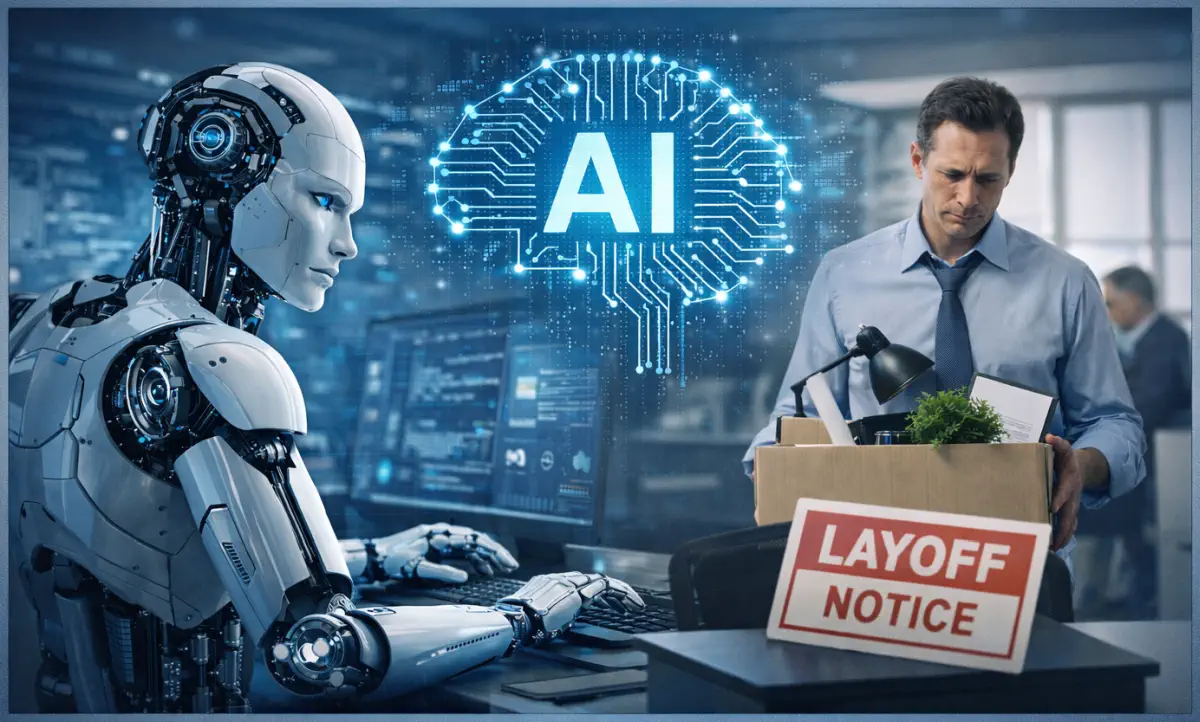
Artificial intelligence is no longer just a helpful assistant — it is emerging as a direct cost-saving replacement for human labor. In a business world driven by margins and competition, that reality changes everything. As AI advances at a rapid pace, companies are actively examining which jobs can be automated or phased out.
Recent reports highlight growing concerns that office and white-collar jobs could be among the first major sectors disrupted.
Artificial Intelligence Is Rapidly Replacing Office and White-Collar Jobs
Several recent articles highlight warnings from tech leaders that AI could soon perform many tasks traditionally handled by human employees. From data analysis and document drafting to scheduling, coding assistance, customer support, and internal reporting, AI systems are reaching performance levels that rival trained professionals.
One report suggests that within the next 12–18 months, AI may achieve near “human-level” capability across many office-based functions. Read the full article on Office Jobs and AI Replacement (UNILAD)
Microsoft’s AI Leadership Warns of Major Workforce Disruption
Additional coverage points to statements from Microsoft’s AI leadership suggesting that rapid improvements in generative AI could significantly reshape professional employment.
The concern centers on roles built around repetitive computer-based work. Finance departments, legal research teams, auditing support, administrative roles, and internal analysts are among the positions frequently cited as vulnerable. See the breakdown of roles Microsoft thinks are at risk (UNILAD)
Additional coverage reinforces the same warning and outlines which types of jobs may be taken over first as AI tools become more reliable and scalable. Read more about the AI job impact story (UNILAD Tech)
Why Businesses Are Accelerating AI Adoption to Reduce Costs and Increase Efficiency
The movement toward artificial intelligence inside companies is not accidental. It is strategic.
AI systems offer something every business prioritizes: lower operating costs combined with increased output.
The Financial Incentives Behind AI Automation
Unlike human employees, AI does not require salaries, healthcare benefits, retirement contributions, or paid leave. Once deployed, it can operate continuously — 24 hours a day — without fatigue.
Automation also reduces administrative overhead. Workflows become streamlined. Repetitive tasks are eliminated. Scaling production no longer requires expanding payroll.
For businesses under pressure to protect margins and remain competitive, AI shifts from being an experimental tool to a long-term operational strategy.
This transition is less about technological excitement and more about financial optimization.
Which Jobs Are Most Vulnerable to Artificial Intelligence Replacement?
While physical trades and hands-on labor remain more resistant to automation for now, digital and knowledge-based roles face increasing exposure.
Knowledge-Based and Computer-Centric Roles at Higher Risk
Positions involving structured processes, data handling, document production, and pattern recognition are especially susceptible. Examples include:
- Administrative and clerical support
- Data entry and reporting roles
- Junior-level legal research
- Financial analysis and auditing assistance
- Customer service and technical support
- Content drafting and certain marketing functions
These roles rely on predictable workflows — precisely the environment where AI systems perform exceptionally well.
And the improvement curve is steep. Tasks that once required teams can, in some cases, now be handled by a single AI-supported workflow.
How AI Automation Is Already Reshaping the Workforce
Artificial intelligence is no longer theoretical inside the workplace. It is being integrated directly into software suites, reporting systems, and operational platforms.
Instead of expanding teams, many companies are testing AI copilots, automated analytics tools, and generative systems capable of producing work once assigned to employees.
This shift is operational, not experimental.
To understand which AI systems are driving this transformation, check out our breakdown of the top 10 leading AI chat and automation services in 2026. These are a large part the tools businesses are evaluating to streamline processes and support decision-making — from customer support to internal workflow automation.
AI Integration Is Quietly Replacing Hiring in Some Roles
Rather than filling open positions, some organizations are implementing automation. In certain cases, staff reductions have followed AI deployment. In others, hiring has slowed in departments considered likely to be automated.
The transition is gradual — but measurable. Workforce strategies are already adjusting to AI capability.
Will Artificial Intelligence Replace Jobs — Or Redefine Them?
The debate is no longer about whether AI affects employment. It already does. The deeper question is how far that impact extends.
Some experts argue AI will primarily augment human workers. In this model, employees move into oversight, strategic planning, creative direction, and higher-level decision-making while automation handles structured tasks.
Fewer Workers, Same Output
Even without total elimination of roles, headcount reduction remains possible. If AI enables one employee to produce what previously required several, businesses may simply need fewer people.
That distinction matters. Workforce transformation still reshapes the labor market — even if the term “replacement” feels too extreme.
The Economic Reality Driving AI Adoption
Artificial intelligence is advancing at a pace few anticipated. What feels innovative today may become standard business practice tomorrow.
At its core, this shift is not purely technological — it is economic.
Businesses operate on margins and competitive pressure. If automation reduces labor expenses, enables continuous operation, and scales output without increasing payroll, adoption becomes a financial necessity. When one company lowers costs through AI, competitors feel compelled to follow.
This does not guarantee mass job elimination. But it does suggest a tightening of workforce structures.
A Defining Moment for the Future of Work
The workforce is already changing. AI systems continue to improve, and companies are evaluating them not just as tools — but as long-term operational strategies.
Whether this leads to gradual adaptation or widespread disruption depends on implementation, regulation, and workforce readiness.
What is clear is this: the next few years will not simply introduce new technology. They may redefine job security, employment stability, and how workforce value is measured in an AI-driven economy.