
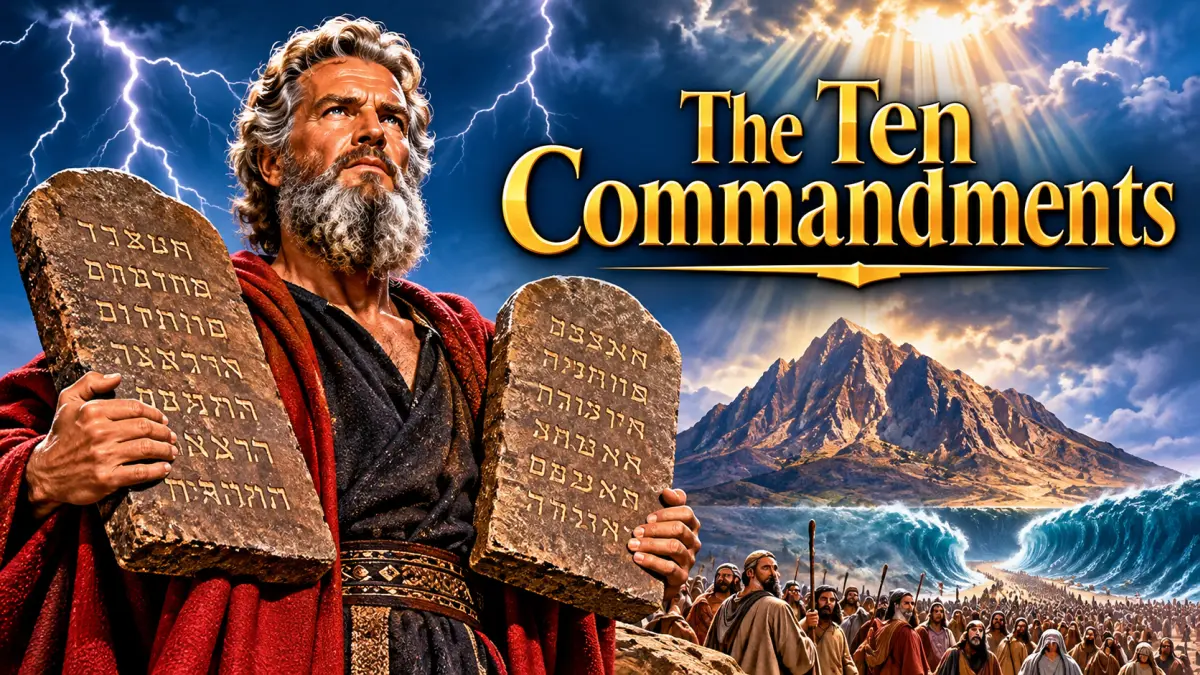
The Ten Commandments is one of the most recognized biblical motion pictures ever produced. Directed by legendary filmmaker Cecil B. DeMille and starring Charlton Heston as Moses, this epic film brings to life the biblical account of Moses, the Israelites’ struggle for freedom from Egyptian slavery, and the receiving of God’s commandments at Mount Sinai.
Originally released in 1956, the movie features spectacular scenery, elaborate sets, dramatic storytelling, and memorable performances. Its story explores faith, freedom, obedience, leadership, and the relationship between humanity and God.
The film follows Moses from his unusual beginnings as an infant discovered in the Nile River, through his upbringing in Pharaoh’s household, his discovery of his Hebrew heritage, and ultimately his calling to lead the Israelites out of Egypt.
Watch the Full Movie: The Ten Commandments (1956)
The History Behind The Ten Commandments
The 1956 production of The Ten Commandments was directed and produced by Cecil B. DeMille and released by Paramount Pictures. It starred Charlton Heston as Moses, Yul Brynner as Pharaoh Rameses, Anne Baxter as Nefertiri, Edward G. Robinson as Dathan, and Yvonne De Carlo as Sephora.
The movie was an ambitious production, filmed in locations including Egypt and the Sinai Peninsula, as well as Hollywood studio sets. Its enormous sets, thousands of extras, elaborate costumes, and groundbreaking visual effects helped establish it as one of Hollywood’s great biblical epics.
The famous parting of the Red Sea sequence became one of the most recognizable special-effects achievements in movie history. The film received seven Academy Award nominations and won the Oscar for Best Visual Effects.
DeMille’s production was based on the biblical books of Exodus and other Old Testament writings, along with historical research and literary works. The filmmaker also included an introductory appearance in which he explained the historical and religious importance of the story.
At its heart, the movie explores an important question: Should humanity be governed by the laws of God or by the power and ambitions of earthly rulers?
Moses and the Calling of God
One of the most important events in the story occurs after Moses has been driven out of Egypt. Having discovered his Hebrew ancestry, Moses leaves behind his privileged position in Pharaoh’s household and eventually finds himself in the land of Midian.
There, he becomes a shepherd, marries Sephora, and begins a very different life away from the Egyptian empire.
But his journey is far from over.
Pharaoh’s Wealth, Forced Labor and the Burden of Taxes
Ancient Egypt was a powerful kingdom ruled by Pharaohs who controlled enormous wealth, agricultural resources, land, and labor. Much of the kingdom’s prosperity depended on the work and production of ordinary people, including farmers, laborers, craftsmen, and people forced into state service.
The biblical account in Exodus describes how the Israelites became an oppressed population under Egyptian rule. Pharaoh feared their growing numbers and worried that they might become powerful enough to threaten his kingdom. In response, he placed Egyptian taskmasters over them and forced them into increasingly difficult labor.
Building an Empire on the Labor of Others
According to Exodus 1:11–14, the Israelites were forced to build storage cities for Pharaoh, including Pithom and Rameses. Their work involved making bricks from mud and straw, constructing buildings, and performing demanding agricultural and field labor.
The workers were not free to determine their own working conditions. Egyptian officials supervised their labor, imposed demands, and used punishment to enforce production.
When Moses and Aaron first approached Pharaoh and demanded the Israelites’ release, Pharaoh responded by making their working conditions even worse.
In Exodus Chapter 5, Pharaoh ordered that the Israelites would no longer receive straw for making bricks. Instead, they would have to gather their own straw while still producing the same required number of bricks.
This meant that the workers were expected to accomplish the same production quotas with less assistance and under even more difficult conditions.
Their complaints were ignored, and the burden of labor continued.
Taxation and the Wealth of the Pharaohs
The exploitation of labor was not limited to the Israelites described in the Bible. Historical research shows that taxation and compulsory labor were important parts of the ancient Egyptian economy.
Egyptians paid taxes in various forms, including grain, livestock, agricultural products, and labor. One particularly demanding system was known as corvée labor, which required people to perform compulsory work for the state.
These labor obligations helped support royal construction projects, temples, irrigation systems, transportation routes, military operations, and other government activities.
The system allowed Pharaohs and government officials to direct enormous amounts of human labor and agricultural production toward the interests of the kingdom.
For ordinary people, this could mean surrendering portions of their harvests, providing goods to the royal treasury, or being required to work on government projects rather than their own livelihoods.
The Power of the Ruler and the Cost to Ordinary People
The story of Moses presents a dramatic example of what happens when political power becomes an instrument of oppression.
Pharaoh controlled the resources of the kingdom and had the authority to determine how entire populations would be treated. The Israelites had little ability to challenge the system imposed upon them.
Their story raises questions that remain relevant throughout history: Who benefits from a nation’s wealth? Who performs the labor that creates it? And what happens when those in power place their own interests above the well-being and freedom of the people?
The Exodus story ultimately presents freedom from forced labor and oppression as a central part of God’s intervention on behalf of the Israelites.
Historical perspective: The Bible specifically describes the Israelites’ forced labor under Pharaoh. Separately, Egyptian historical records and scholarship document taxation and compulsory labor systems. These broader practices help explain the economic structure of ancient Egypt, although they do not establish that every Egyptian tax or labor obligation was imposed on the Israelites in exactly the same way.
The Burning Bush – God’s Appearance to Moses
While tending sheep near Mount Sinai, Moses witnesses something extraordinary: a bush engulfed in flames that does not burn up.
Curious about this unusual sight, Moses approaches the burning bush. Suddenly, God calls to him by name.
Moses answers, and God instructs him to remove his sandals because he is standing on holy ground.
God identifies himself as the God of Abraham, Isaac, and Jacob, establishing a connection to the promises made to the ancestors of the Hebrew people.
The encounter is especially significant because God tells Moses that he has heard the suffering of the Israelites in Egypt. He has witnessed their oppression and intends to deliver them from slavery.
God then gives Moses a mission: Return to Egypt, confront Pharaoh, and lead the Israelites out of bondage.
Moses questions whether he is capable of carrying out such an enormous responsibility. He wonders why Pharaoh would listen to him and what he should say to the Israelites when they ask who sent him.
God reassures Moses that he will be with him and reveals the name by which he is to identify himself:
“I AM THAT I AM.”
This encounter is recorded in Exodus Chapter 3 and represents the beginning of Moses’ divine mission.
The burning bush is more than a miraculous event. It represents God’s presence, the beginning of a covenantal mission, and the moment Moses is chosen to become the deliverer of his people.
The Journey to Freedom
Moses returns to Egypt and confronts Pharaoh, demanding that he release the Hebrew slaves.
Pharaoh refuses, setting in motion the series of plagues described in the Book of Exodus. These events demonstrate the conflict between Pharaoh’s authority and the power of the God of Israel.
Eventually, after the final plague, Pharaoh allows the Israelites to leave.
However, Pharaoh changes his mind and sends his army after them.
The Israelites find themselves trapped between the approaching Egyptian army and the Red Sea. Moses raises his staff, and the waters separate, allowing the people to cross on dry ground. When the Egyptian army follows, the waters return, overwhelming Pharaoh’s forces.
The Israelites have escaped Egypt, but their journey toward the land promised to them is only beginning.
Mount Sinai – God Gives Moses the Ten Commandments
Following their escape from Egypt, Moses leads the Israelites through the wilderness toward Mount Sinai.
This is where the story reaches one of its most significant moments.
According to the biblical account, God calls Moses up the mountain and establishes a covenant with the Israelites. The mountain becomes surrounded by smoke, thunder, lightning, and the sound of a trumpet. The people are instructed to keep their distance because the mountain has been set apart as holy.
God then speaks the commandments that will establish the moral and spiritual foundation of the Israelite community.
Moses receives the commandments on two stone tablets.
These laws address humanity’s relationship with God, as well as how people should treat one another. They establish principles involving worship, honesty, family, respect for life, marriage, property, and personal conduct.
The commandments are recorded in Exodus Chapter 20.
The Ten Commandments Explained
1. You shall have no other gods before Me.
God commands the Israelites to recognize him as their one supreme God. Their worship and devotion are not to be directed toward other gods or competing objects of religious allegiance.
2. You shall not make for yourself a graven image.
This commandment prohibits making idols or images to worship as gods. It warns against replacing the worship of God with physical objects or representations.
3. You shall not take the name of the Lord your God in vain.
God’s name is to be treated with reverence and respect. This commandment prohibits using his name carelessly, dishonestly, or disrespectfully.
4. Remember the Sabbath day and keep it holy.
The seventh day is designated as a day of rest and religious observance. People are instructed to work during six days and dedicate the seventh day to rest and God.
5. Honor your father and your mother.
Children are commanded to respect and honor their parents. This commandment emphasizes the importance of family relationships, respect, and responsibility between generations.
6. You shall not murder.
Human life is to be respected. This commandment establishes the prohibition against unlawfully taking another person’s life.
7. You shall not commit adultery.
Marriage and marital faithfulness are to be respected. This commandment prohibits sexual betrayal and emphasizes the importance of fidelity.
8. You shall not steal.
People are forbidden from taking what belongs to others. This establishes the importance of respecting personal property and the rights of other individuals.
9. You shall not bear false witness against your neighbor.
People are commanded to tell the truth and avoid dishonesty, false accusations, and deceptive testimony that could harm another person.
10. You shall not covet what belongs to your neighbor.
People are warned against excessive desire for another person’s possessions, spouse, property, or belongings. This commandment addresses not only outward actions but also the intentions and desires within a person’s heart.
Together, these commandments establish a framework for religious devotion, personal responsibility, and ethical behavior.
Note: The numbering and grouping of the Ten Commandments differ somewhat among Jewish, Catholic, and Protestant traditions, although the underlying biblical passages are the same.
The Golden Calf – When the Israelites Turn Away
One of the most memorable portions of the movie occurs after Moses receives the commandments.
While Moses is away on Mount Sinai, the Israelites become impatient and uncertain about his return. They turn to Aaron and demand that he make them a god they can see and worship.
A golden calf is created, and the people begin celebrating and worshipping it.
This event directly violates the commandments God has given Moses, particularly those concerning the worship of other gods and the creation of idols.
When Moses descends from the mountain carrying the stone tablets, he discovers the people celebrating around the golden calf.
Angered by what he sees, Moses throws the tablets down and shatters them.
The scene illustrates the seriousness of the covenant between God and the Israelites and the consequences of turning away from the instructions they had received.
The biblical account also describes Moses interceding for the people and eventually receiving replacement tablets.
The episode is recorded in Exodus Chapters 32–34.
The Lasting Significance of the Ten Commandments
The Ten Commandments have influenced religious beliefs, moral teachings, legal traditions, and cultural discussions for thousands of years.
They remain central to Judaism and Christianity and are also recognized within Islam as part of the broader religious tradition surrounding Moses, who is known as Musa in Islam.
Although different religious traditions interpret and organize the commandments differently, their themes continue to be discussed throughout the world.
The commandments address questions that remain relevant today:
- How should people treat one another?
- What responsibilities do individuals have toward their families?
- Why are honesty and respect important?
- What does it mean to live a moral life?
- Should power and authority be limited by higher principles?
The Ten Commandments is more than a historical biblical drama. It is a story about freedom from oppression, the responsibilities that come with freedom, and the importance of living according to principles greater than personal ambition.
Whether watched as a religious story, a historical epic, or a landmark achievement in filmmaking, Cecil B. DeMille’s production remains a remarkable interpretation of one of the most influential stories in religious history.
Further Reading and Historical References
For readers interested in learning more about Moses, the Exodus, Mount Sinai, and the origins of the Ten Commandments, the following resources provide additional information.
The Biblical Account
- Exodus Chapter 3 – Moses and the Burning Bush
- Exodus Chapter 19 – God and Mount Sinai
- Exodus Chapter 20 – The Ten Commandments
- Exodus Chapters 32–34 – The Golden Calf and Replacement Tablets
- Deuteronomy Chapter 5 – The Ten Commandments Revisited
Movie History and Production
- American Film Institute – The Ten Commandments (1956)
- Paramount Pictures – The Ten Commandments
- Cecil B. DeMille – The History Behind the Film
Additional Historical Research