
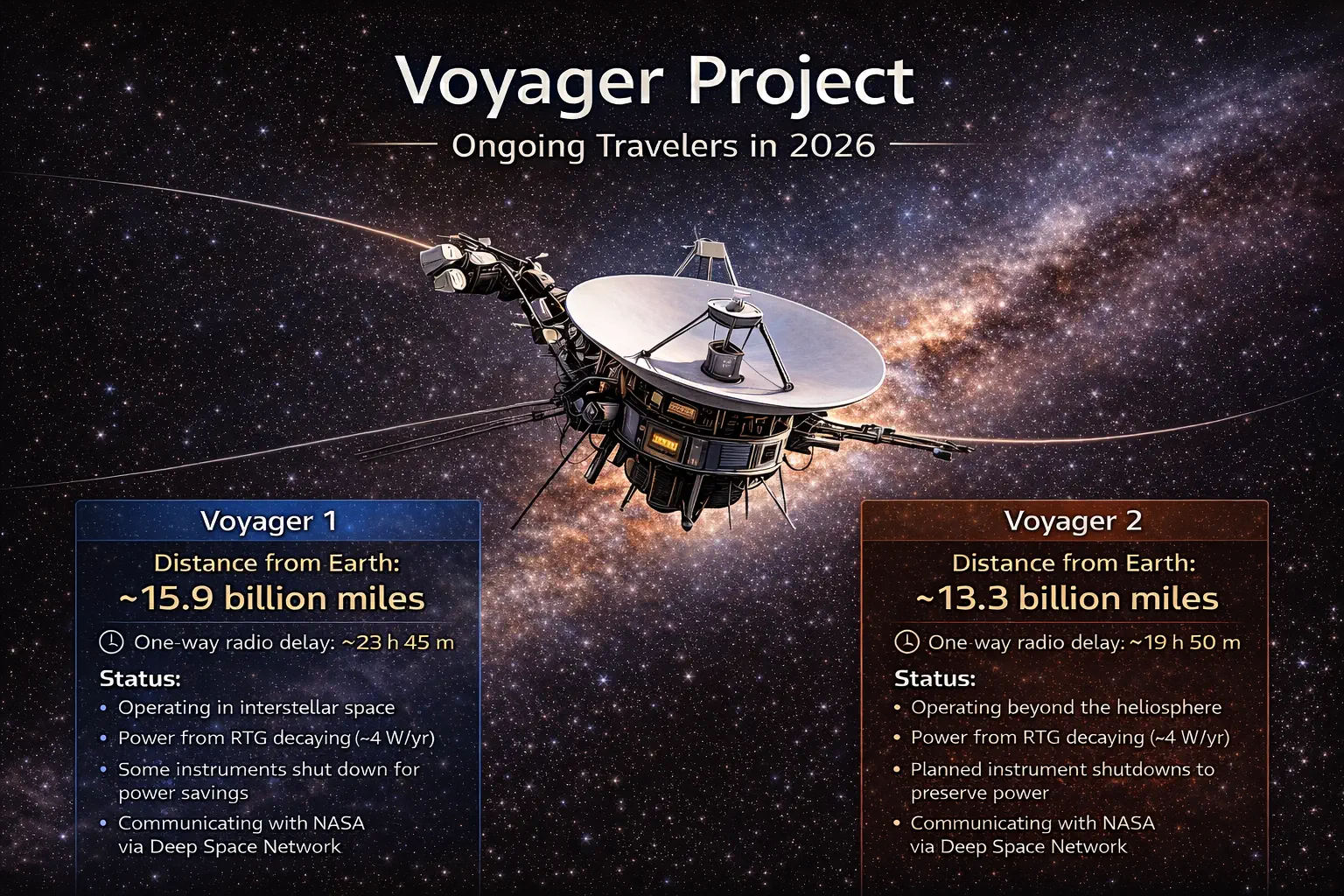
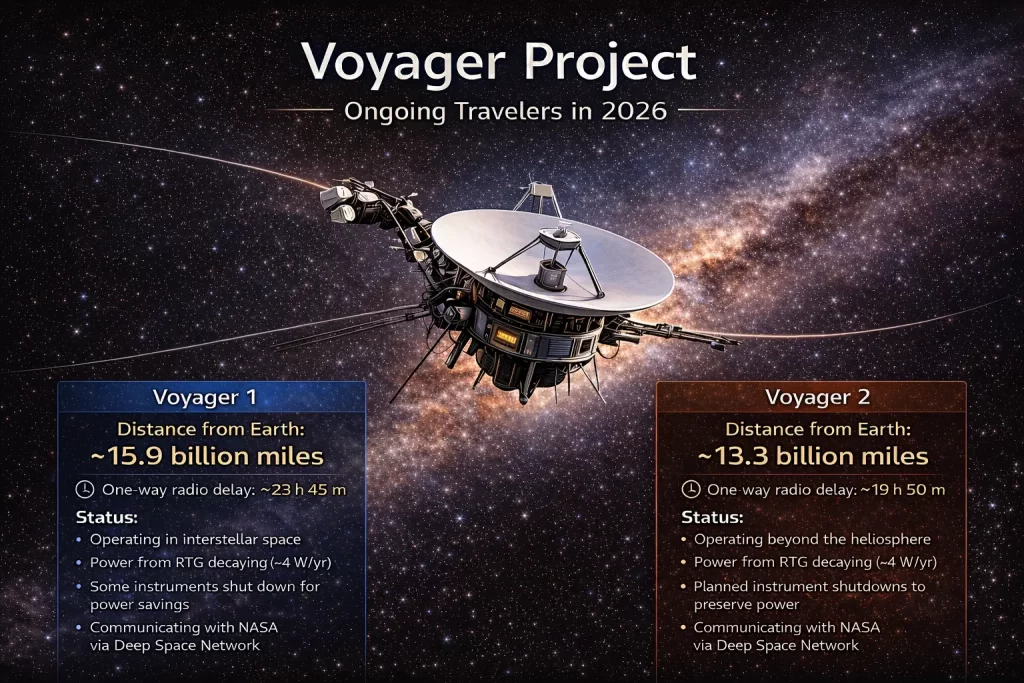
In the vast expanse of space, two intrepid explorers continue to push the boundaries of human achievement. NASA’s Voyager 1 and Voyager 2, launched in 1977, have been journeying through the cosmos for nearly five decades. As we step into 2026, these spacecraft are not only humanity’s farthest messengers but also symbols of enduring ingenuity. In 2025, they achieved remarkable milestones amid ongoing challenges, including power conservation efforts and engineering triumphs. This post dives into their rich history, current status, recent updates, and what’s on the horizon for 2026.
A Brief History of the Voyager Mission
The Voyager program was born from a rare planetary alignment in the late 1970s, allowing for a “Grand Tour” of the outer solar system. Voyager 2 launched first on August 20, 1977, from Cape Canaveral, Florida, aboard a Titan-Centaur rocket. Its twin, Voyager 1, followed on September 5, 1977, on a faster trajectory that would see it overtake Voyager 2.
Both probes were designed to study Jupiter and Saturn, but Voyager 2’s path was extended to include Uranus and Neptune—the only spacecraft to visit these ice giants. Key historical highlights include:
- Jupiter Flybys (1979): Voyager 1 and 2 revealed active volcanoes on Io (the first evidence of volcanism beyond Earth) and intricate details of Jupiter’s atmosphere and moons.
- Saturn Flybys (1980-1981): Images of Saturn’s rings, Titan’s hazy atmosphere, and new moons expanded our understanding of the ringed planet.
- Uranus and Neptune (1986-1989, Voyager 2 only): Discoveries included Uranus’ extreme axial tilt and bizarre magnetic field, plus Neptune’s Great Dark Spot and supersonic winds.
- Interstellar Transition: Voyager 1 crossed the heliopause (the boundary where the Sun’s influence gives way to interstellar space) on August 25, 2012, at about 121 AU from the Sun. Voyager 2 followed on November 5, 2018, at around 119 AU, providing unique plasma data to confirm the crossing.
After their planetary encounters, the probes diverged: Voyager 1 headed northward out of the ecliptic plane toward the constellation Ophiuchus, while Voyager 2 veered southward toward Pavo. Their radioisotope thermoelectric generators (RTGs) have powered them through the decades, though output decays by about 4 watts per year.
The Pioneer Connection: Pathfinders for Voyager
The Voyager mission didn’t emerge in isolation—it built directly on the groundbreaking work of NASA’s Pioneer 10 and Pioneer 11 probes, launched in 1972 and 1973 respectively. These earlier spacecraft were true pioneers (fitting their name), serving as risk-reducing precursors that made Voyager possible.
- Proving the Path: Pioneers 10 and 11 were NASA’s first attempts to send probes beyond the asteroid belt and through Jupiter’s harsh radiation environment. Pioneer 10 achieved the first Jupiter flyby (December 1973) and became the first human-made object to escape the Sun’s gravity. Pioneer 11 followed with Jupiter (1974) and the first Saturn flyby (1979). Their success provided critical data on radiation hazards, micrometeoroid risks, and gravity-assist techniques—essential for Voyager’s more complex trajectories.
- Inspiring the Message: Each Pioneer carried a small gold-anodized aluminum plaque (the “Pioneer plaque”) with symbolic etchings: human figures (nude man and woman for scale), a diagram of our solar system, pulsar directions to locate the Sun, and a hydrogen atom transition as a universal unit of length/time. This minimalist “We are here” greeting directly inspired the Voyager Golden Records, which expanded the idea into a richer audiovisual time capsule.
- Interstellar Legacy: Pioneers 10 and 11 were the first spacecraft on interstellar trajectories, though they went silent decades ago (last signals: 2003 for Pioneer 10, 1995 for Pioneer 11). Voyagers overtook them in distance during the 1990s and continue operating today, extending the exploration Pioneers began.
Without the Pioneers’ daring firsts and hard-won lessons, the Voyagers’ epic journey—and their status as humanity’s farthest, still-active messengers—might never have unfolded as it did.
| Aspect | Pioneer 10/11 (1972-1973) | Voyager 1/2 (1977) |
|---|---|---|
| Primary Targets | Jupiter (both); Saturn (Pioneer 11 only) | Jupiter & Saturn (both); Uranus & Neptune (Voyager 2) |
| Firsts Achieved | First asteroid belt crossing, first Jupiter flyby, first solar escape | First detailed outer planet “Grand Tour,” first interstellar crossings with data |
| Message Carried | Pioneer plaque (simple pictorial/symbolic) | Golden Records (audio, images, music, greetings) |
| Current Status | Inert, drifting interstellar; no signals | Active (minimal instruments), sending data |
| Farthest Distance | Overtaken by Voyagers in 1990s | Voyager 1: farthest human object (~171 AU as of 2026) |
The Voyager Golden Records: Humanity’s Message to the Stars
Aboard both Voyager 1 and Voyager 2 rides one of the most poetic payloads ever launched: the Voyager Golden Record. Conceived as a “bottle in the cosmic ocean,” this 12-inch gold-plated copper phonograph disk serves as a time capsule portraying the diversity of life and culture on Earth. It was assembled by a committee chaired by astronomer Carl Sagan of Cornell University, who worked with colleagues to select contents that could convey our planet’s story to any potential extraterrestrial discoverers.
The record includes:
- 115 images (encoded in analog form): Depicting scientific concepts (e.g., DNA structure, mathematical definitions, solar system parameters), natural scenes (e.g., landscapes, weather phenomena), human anatomy, technology, architecture, and cultural diversity.
- Sounds of Earth: A collection of natural and human-made audio, including surf, wind, thunder, birds, whales, other animals, footsteps, laughter, tools, vehicles, and a “United Nations greetings / whale songs” segment.
- Spoken greetings in 55 languages: Ranging from ancient Akkadian (spoken in Sumer ~6,000 years ago) to modern Wu (a Chinese dialect), plus messages from U.N. Secretary-General Kurt Waldheim and U.S. President Jimmy Carter.
- Music selections (~90 minutes): An eclectic mix from various cultures and eras, including Bach’s Brandenburg Concerto No. 2, Beethoven symphonies and quartets, Mozart, Chuck Berry’s “Johnny B. Goode,” traditional pieces from China, India, Japan, Peru, Navajo chants, and more—representing both Eastern and Western classics alongside ethnic music.
- Unique personal touch: A recording of the brainwaves (EEG) of Ann Druyan (creative director and Carl Sagan’s partner), captured as she thought about love, Earth, and humanity.
Each record is encased in a protective aluminum jacket with a cartridge and needle for playback at 16⅔ rpm. The cover features symbolic instructions (in universal diagrams) on how to play the record, locate Earth using pulsar maps, and determine the elapsed time via hydrogen atom transitions. The phrase “per aspera ad astra” (“through struggle to the stars”) is included in Morse code.
As Carl Sagan noted, the record’s true value lies in what it says about us: a hopeful gesture of curiosity and connection, even if the chances of it being found are slim—it may take 40,000 years to approach another star system.
Milestones and Challenges in 2025
2025 was a pivotal year for the Voyagers, marked by innovative engineering to extend their lifespans despite dwindling power. NASA’s Jet Propulsion Laboratory (JPL) team faced aging hardware and communication delays but delivered key successes:
- Instrument Shutdowns for Power Conservation: In March 2025, NASA turned off the low-energy charged particle (LECP) instrument on both probes to prioritize remaining science operations. Voyager 2’s plasma science (PLS) instrument had already been deactivated in late 2024. These decisions aim to keep at least one instrument operational into the 2030s.
- Voyager 1 Thruster Revival: In May 2025, engineers successfully revived backup thrusters on Voyager 1 after a glitch in 2024 caused communication issues. This occurred just before a months-long pause in commands due to upgrades on NASA’s Deep Space Network (DSN) antenna in Canberra, Australia (DSS-43), from May 2025 to February 2026.
- Ongoing Data Collection: Despite reductions, the probes continued sending valuable interstellar data on cosmic rays, magnetic fields, and plasma waves, offering insights no other mission can match.
These efforts underscore the mission’s resilience, with the team describing the Voyagers as “senior citizens” still contributing to science.
Current Status (as of January 2026)
As of early January 2026, both Voyagers are operating in interstellar space, far beyond the planets. Voyager 1 remains the farthest human-made object, with communication times stretching to nearly a full day one-way. Below is a summary table of their statuses, based on NASA’s latest reports and tracking data:
| Aspect | Voyager 1 | Voyager 2 |
|---|---|---|
| Distance from Earth | ~15.9 billion miles (~25.6 billion km) / ~171 AU | ~13.3 billion miles (~21.4 billion km) / ~143 AU |
| Distance from Sun | ~15.9 billion miles (~25.6 billion km) / ~171 AU | ~13.3 billion miles (~21.4 billion km) / ~143 AU |
| Speed | ~38,000 mph (~61,000 km/h) / ~3.6 AU/year | ~34,000 mph (~55,000 km/h) / ~3.1 AU/year |
| One-Way Light Time | ~23 hours 45 minutes | ~19 hours 50 minutes |
| Active Instruments | Magnetometer (MAG), Plasma Wave Subsystem (PWS); Cosmic Ray Subsystem (CRS) off Feb 2025; LECP off early 2026 | Magnetometer (MAG), Plasma Wave Subsystem (PWS); CRS projected off 2026; PLS off 2024; LECP off Mar 2025 |
| Power Status | RTGs at ~60% original output; ~4W/year decay; reserves used to extend ops | Similar to Voyager 1; prioritized for interstellar medium measurements |
| Direction | Northward, toward Ophiuchus | Southward, toward Pavo |
Data sourced from NASA’s Voyager mission status and related updates. The probes rely on the DSN for faint signals, with recent upgrades ensuring continued contact.
2026 Outlook: Pushing Further into the Cosmos
Looking ahead, 2026 promises another historic milestone for Voyager 1: reaching one light-day from Earth around November 13-15, 2026. At this distance (~16 billion miles / ~25.9 billion km), a one-way radio signal will take 24 hours to arrive, making round-trip communications a two-day affair—a first for any spacecraft. This “cosmic barrier” symbolizes the immense scale of space and humanity’s reach.
For both probes:
- Power Management: Further instrument shutdowns are likely, with the cosmic ray subsystem (CRS) on Voyager 2 potentially next in 2026. Optimistic projections suggest operations could continue into the early 2030s with minimal instruments, possibly through the 50th launch anniversary in 2027.
- Scientific Value: They’ll keep providing data on interstellar plasma, charged particles, magnetic fields, and cosmic rays, helping scientists understand the heliosphere’s edge and beyond. No new missions are planned to replicate this soon.
- Challenges Ahead: Fading power and potential hardware failures loom, but JPL’s creative solutions—like software patches from Earth—have kept them going.
The Voyagers’ journey reminds us that exploration doesn’t end at the solar system’s edge; it evolves into a quest through the stars.
Resources and Further Reading
For the latest factual updates, check these official sources:
- NASA Voyager Mission Overview – General info on the program.
- Voyager Real-Time Status Tracker – Live distances, speeds, and instrument statuses.
- Voyager News and Updates – Recent articles on milestones and engineering feats.
- The Voyager Golden Record Overview – Details on the record and its purpose.
- Golden Record Contents – Images, sounds, music, and greetings breakdowns.
- Golden Record Images – Full list of the 115 pictures.
- Golden Record Sounds and Music – Audio selections and natural sounds.
- Golden Record Greetings – The 55 languages and messages.
- NASA’s Deep Space Network – Details on how we communicate with the probes.
Stay tuned for more as these pioneers venture deeper—proof that with curiosity and engineering, we can touch the infinite. What are your thoughts on the Voyagers’ legacy, the Pioneer connection, or the Golden Record? Share in the comments!