
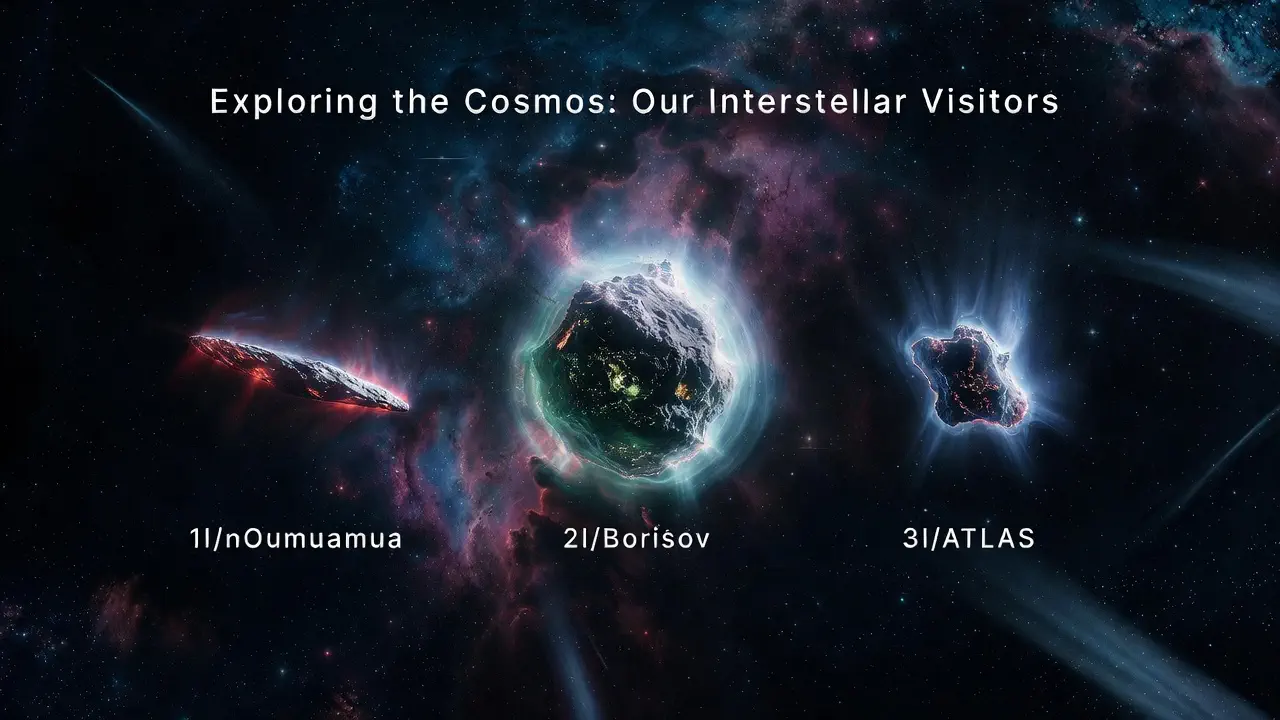
The vast expanse of space is not just a backdrop for our solar system—it’s a highway for wandering objects ejected from distant stars. Since 2017, astronomers have confirmed three such interstellar interlopers passing through our neighborhood: 1I/ʻOumuamua, 2I/Borisov, and the most recent, 3I/ATLAS. These rare visitors offer a glimpse into the chemistry, dynamics, and histories of other stellar systems. In this article, we’ll dive into the known facts about each, compare their striking differences, and speculate on their possible origins based on current scientific understanding. As of early 2026, these objects continue to fuel research and debate in the astronomical community.
1I/ʻOumuamua: The Pioneering Puzzle
Discovered on October 19, 2017, by the University of Hawaii’s Pan-STARRS1 telescope, 1I/ʻOumuamua holds the distinction of being the first confirmed interstellar object to visit our solar system. This elongated, cigar-shaped wanderer measures roughly 400 meters in length and tumbles end-over-end, a motion suggesting it endured a violent ejection from its home system long ago. Traveling at an astonishing 196,000 mph (about 54 miles per second), it zipped past the Sun on September 9, 2017, at a closest approach of about 0.25 astronomical units (AU)—closer than Mercury’s orbit.
Unlike typical comets, ʻOumuamua showed no visible coma or tail, initially classifying it as an asteroid-like body. However, observations revealed subtle non-gravitational acceleration, hinting at outgassing from volatile ices like hydrogen or nitrogen—behavior more akin to a comet, though without the usual dust or gas emissions. Its reddish hue suggests a surface rich in organic compounds, battered by cosmic rays over eons. Spectroscopic analysis showed no signs of water or carbon-based molecules typically seen in solar system objects, adding to its enigma.
Speculation on its origin points to a binary star system, where gravitational interactions could fling out rocky fragments more easily than from single-star setups. Some models suggest it might be a shard of a Pluto-like exo-planet, disrupted by tidal forces. Tracing its trajectory backward, ʻOumuamua’s path doesn’t pinpoint a single star, but it likely hails from within 3,000 light-years, possibly from the direction of the constellation Lyra. Its near-rest velocity relative to the local standard of rest (LSR) before entering our system is unusual for natural ejections, sparking fringe theories of artificial origins, though most evidence supports a natural formation.
2I/Borisov: The Gassy Wanderer from Afar
Fast-forward to August 30, 2019, when amateur astronomer Gennady Borisov spotted 2I/Borisov using a homemade telescope in Crimea. This was the first unambiguous interstellar comet, complete with a bright coma and tail from sublimating ices as it approached the Sun. Estimated at 0.2 to 0.5 kilometers in diameter, it barreled through at 33 km/s (about 74,000 mph), making its closest solar approach on December 8, 2019, at 2 AU.
Compositionally, Borisov stands out as remarkably pristine—likely untouched by close stellar passes since its formation. Hubble and ALMA observations revealed a high carbon monoxide (CO) to water ratio, up to 35% CO—far exceeding most solar system comets, suggesting formation in a cold, distant region of its parent system. It also showed polarized light in its coma, indicating minimal alteration over its journey. In March 2020, it partially fragmented, likely due to thermal stresses from solar heating, ejecting chunks observed by telescopes.
As for origins, models favor ejection from a red dwarf binary system, with Kruger 60—a pair of red dwarfs 13 light-years away—emerging as a strong candidate based on trajectory backtracking. It entered from the direction of Cassiopeia, possibly via a three-body encounter in a planetary or binary setup. This implies Borisov formed around low-mass stars, common in the galaxy, and its giant-planet-hosting system could have stirred up distant icy bodies.
3I/ATLAS: The Ancient Interloper
The latest addition, 3I/ATLAS (also C/2025 N1), was discovered on July 1, 2025, by the Asteroid Terrestrial-impact Last Alert System (ATLAS) in Chile. As the third confirmed interstellar comet, it’s estimated to be several kilometers wide and exhibits a coma with unusual spectroscopic activity, including mysterious emissions that puzzled early observers. Traveling at high interstellar speeds, it poses no threat to Earth and will swing by the Sun before exiting the system.
NASA’s multi-telescope campaign revealed strange chemistry: high levels of heavy elements and isotopes suggesting formation in an older stellar system, possibly predating our own 4.6-billion-year-old Sun. It’s considered one of the oldest comets observed, with a composition hinting at a metal-rich birthplace. Unlike Borisov, ATLAS shows signs of being less pristine, with potential weathering from cosmic radiation over billions of years. Conspiracy theories of alien technology were debunked by detailed spectra confirming natural cometary processes, though debates persist.
Origin-wise, ATLAS approaches from Sagittarius, likely ejected from the Milky Way’s bulge or thick disk—regions teeming with ancient stars. No specific star system has been identified, but its kinematics suggest a high-velocity ejection from a dense stellar environment, perhaps billions of years ago. This could mean it originated in a system with massive stars or black holes that disrupted planetary disks.
Avi Loeb’s Checklist of Anomalies for 3I/ATLAS
Harvard astrophysicist Avi Loeb, known for his provocative theories on interstellar objects like ʻOumuamua, has proposed a checklist of anomalies for 3I/ATLAS that he argues could suggest artificial origins, though he emphasizes these are speculative and rates their combined likelihood at around 40% for extraterrestrial technology. Using his “Loeb Scale” for classifying interstellar objects (where Level 4 indicates multiple anomalies warranting further scrutiny), he places ATLAS at Level 4, similar to ʻOumuamua. Here’s a summary of his key anomalies, organized by increasing likelihood (P values represent estimated probabilities of natural occurrence), drawn from his writings:
- P<0.00004 (Jupiter encounter): The object’s forecasted distance from Jupiter on March 16, 2026, matches Jupiter’s Hill radius precisely, potentially allowing deployment of satellites at stable Lagrange points.
- P=0.00005 (Fine-tuned arrival): Its timing enables close passes by Mars, Venus, and Jupiter while being unobservable from Earth at perihelion.
- P<0.001 (Mass and speed): Roughly a million times more massive than ʻOumuamua and faster, implying targeted entry rather than random drift.
- P<0.001 (Sunward jet/anti-tail): A genuine sunward extension, possibly for protection against impacts.
- P<0.001 (Nickel abundance): High nickel-to-iron and nickel-to-cyanide ratios, akin to industrial alloys.
- P=0.002 (Retrograde trajectory): Aligned within 5 degrees of the ecliptic, suggesting design.
- P=0.006 (Wow! Signal direction): From within 9 degrees of the 1977 Wow! Signal.
- P<0.01 (Negative polarization): Extreme and unprecedented, possibly linked to the anti-tail.
- P<0.1 (Low water content): Only 4% water in the plume, unlike solar system comets.
- P<0.1 (Brightening and color): Rapid brightening near perihelion, bluer than the Sun.
- P<0.1 (Jets and acceleration): Multi-directional jets and non-gravitational acceleration without breakup.
Loeb advocates for open-minded investigation via projects like Galileo, but astronomers like Jason Wright argue these anomalies stem from statistical errors, observational biases, and natural cometary processes. Recent studies affirm ATLAS as a natural comet, with Loeb conceding it’s “most likely” natural while not ruling out artificiality.
Comparing the Trio: Differences and Insights
While all three share hyperbolic orbits confirming their extrasolar origins, their differences highlight the diversity of interstellar wanderers. Note that speeds are given as the hyperbolic excess velocity (v∞, the asymptotic speed far from the Sun, a standard metric for interstellar objects) for consistency, with perihelion maxima noted where relevant.
| Aspect | 1I/ʻOumuamua | 2I/Borisov | 3I/ATLAS |
|---|---|---|---|
| Type | Asteroid-like (possible comet) | Active comet | Active comet |
| Size | ~400 m long, elongated | 0.2–0.5 km diameter | Several km wide |
| Speed | ~26 km/s (v∞) | ~32 km/s (v∞) | ~58 km/s (v∞; up to ~68 km/s at perihelion) |
| Composition | Reddish, organic-rich; low volatiles | High CO (35%), pristine ices | Heavy elements, ancient isotopes; low water (4%), high CO₂ |
| Behavior | Tumbling, non-grav accel. | Coma/tail, partial breakup | Unusual spectra, coma active; anti-tail jets |
| Discovery | 2017, post-perihelion | 2019, pre-perihelion | 2025, inbound |
| Pristine? | Moderately altered | Highly pristine | Less pristine, ancient |
ʻOumuamua’s rocky, inert nature contrasts with the icy, outgassing comets Borisov and ATLAS, suggesting different formation environments—perhaps disrupted planets vs. distant Oort-like clouds. Borisov’s youthfulness implies a recent ejection, while ATLAS’s age points to a longer cosmic trek. Trajectories vary: ʻOumuamua from Lyra, Borisov from Cassiopeia, ATLAS from Sagittarius.
Potential Biosignatures: Clues to Extraterrestrial Life?
In the context of interstellar objects like 1I/ʻOumuamua, 2I/Borisov, and 3I/ATLAS, biosignatures refer to detectable indicators of past or present biological activity—chemical, isotopic, or structural features that are difficult to explain without invoking life. These could include complex organic molecules, unusual isotopic ratios, or even microscopic structures suggestive of cellular life. While no confirmed biosignatures have been detected in these visitors (current observations rely on remote spectroscopy and photometry, which are limited), their compositions and origins open doors to speculation. If we could rendezvous with or sample such objects—perhaps via future missions like those proposed by the Galileo Project—direct analysis could reveal delicate organics preserved from their home systems.
For ʻOumuamua, potential biosignatures might include chiral imbalances in amino acids or exotic polymers resembling DNA precursors, shielded by its tumbling motion. Borisov’s high CO and pristine ices could harbor complex organics like glycine, with disequilibrium gases hinting at biological mediation. ATLAS’s CO₂-dominated coma and heavy elements might show water-related organics or enzymatic traces, such as nickel enrichments linked to extremophiles. Across the trio, these features overlap with prebiotic chemistry, but distinguishing them from abiotic processes remains challenging without closer study. They underscore that life’s building blocks are widespread, potentially linking to broader theories like panspermia.
Panspermia Theories: Seeding Life Across the Stars
Panspermia is the hypothesis that life, or its precursors, can be distributed throughout the universe via natural cosmic processes, essentially “seeding” planets from afar. There are several variants: lithopanspermia (microbes surviving in rocks ejected from one planet to another), ballistic panspermia (transfer within a solar system), and directed panspermia (intentional spreading by intelligent civilizations using probes or comets). The idea dates back to ancient philosophers like Anaxagoras but gained modern traction through scientists like Francis Crick and Svante Arrhenius, who proposed spores propelled by radiation pressure.
What makes panspermia so fascinating? It challenges the notion that life originated solely on Earth, suggesting instead that we’re part of a galactic web of biology—potentially making extraterrestrial life more common and interconnected. It addresses the “where did life come from?” puzzle by outsourcing abiogenesis to harsher or more favorable cosmic environments, while experiments show microbes can survive space conditions, like on the International Space Station. Ethically and philosophically, directed panspermia raises questions about intervening in alien ecosystems.
Relating to our interstellar visitors, objects like ʻOumuamua and Borisov imply a high density of such wanderers—up to 100,000,000 times more than previously thought—boosting panspermia’s plausibility as a mechanism for life transfer. Their potential biosignatures, such as organics or isotopic anomalies, could be evidence of panspermia in action: if detected, they might carry “fossilized” life from distant systems, proving life hops between stars. For instance, ʻOumuamua’s properties have been used to model panspermia efficiency, showing such objects could deliver viable microbes over interstellar distances.
Speculating on Their Journeys: Where Did They Come From?
These objects could be messengers from diverse stellar nurseries. ʻOumuamua might stem from a binary system with a Pluto analog, ejected via gravitational slingshots. Borisov, with its CO-rich makeup, likely formed around a red dwarf like Kruger 60, where giant planets or binary dynamics hurled it into the void. ATLAS, the elder, may hail from the galactic bulge’s chaotic stellar clusters, flung out by interactions with massive bodies in a metal-rich, ancient system.
If more such visitors arrive, they could reveal patterns—like a preference for red dwarf ejections, given those stars’ abundance. Speculatively, they might even carry biosignatures from habitable zones, though current data shows no such evidence. As telescopes improve, we may trace more precise origins, turning these drifters into maps of the galaxy’s history—and perhaps evidence for panspermia.
In summary, ʻOumuamua, Borisov, and ATLAS aren’t just cosmic curiosities—they’re windows into the universe’s interconnectedness. With ongoing missions and observations, who knows what the next interstellar guest will reveal?
Further Reading & Sources
- NASA Science: 1I/ʻOumuamua Overview – https://science.nasa.gov/solar-system/comets/oumuamua/
- NASA/ESA Hubble: Interstellar Comet 2I/Borisov – https://science.nasa.gov/missions/hubble/interstellar-comet-borisov-reveals-its-chemistry-and-possible-origins/
- ALMA Observatory: Unusual Composition of 2I/Borisov – https://www.almaobservatory.org/en/press-releases/alma-reveals-unusual-composition-of-interstellar-comet-2i-borisov/
- NASA Science: Comet 3I/ATLAS Overview and Discovery – https://science.nasa.gov/solar-system/comets/3i-atlas/
- NASA Hubble: Size Estimate and Observations of 3I/ATLAS – https://science.nasa.gov/missions/hubble/as-nasa-missions-study-interstellar-comet-hubble-makes-size-estimate/
- Avi Loeb (Medium): Anomalies of 3I/ATLAS, Organized by Likelihood – https://avi-loeb.medium.com/anomalies-of-3i-atlas-organized-by-likelihood-af20fb3b6d21
- Avi Loeb (Medium): The 15 Anomalies of 3I/ATLAS – https://avi-loeb.medium.com/the-15-anomalies-of-3i-atlas-should-we-pay-attention-to-them-if-they-were-not-forecasted-77375f9974d5
- Wikipedia (for cross-reference): 3I/ATLAS – https://en.wikipedia.org/wiki/3I/ATLAS
- ESA: Comet 3I/ATLAS FAQ – https://www.esa.int/Science_Exploration/Space_Science/Comet_3I_ATLAS_frequently_asked_questions
While this is likely not related to the Classic Asteroids Game or any real Space Invaders, we thought it would be fun to share the links here.