


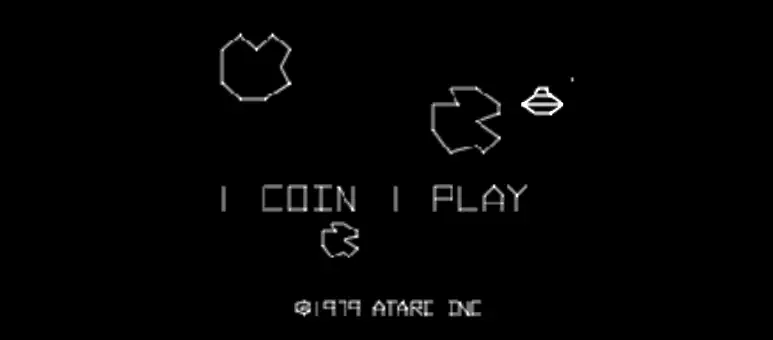
That Familiar Glow The crisp white lines on a black screen, the steady beeps, the triangular ship rotating and thrusting through floating rocks — Asteroids captured something special when it arrived in arcades in late 1979. While not the first video game, it became one of the most influential, popularizing vector graphics, wrap-around playfields, and high-score chasing in a way few titles had before. For many, including myself, it was the next big step after Space Invaders.
The Origin and Impact of Asteroids
Designed primarily by Ed Logg at Atari, with input from Lyle Rains, Asteroids was developed in roughly six months and released in November 1979. Logg drew inspiration from earlier vector-based titles like Spacewar! (1962) and aimed to create a game where the player had complete freedom of movement in an open space environment.
The game ran on Atari’s custom vector display hardware, producing sharp, glowing lines instead of pixelated sprites. Core gameplay included:
- Controlling a small triangular ship that could rotate left/right, thrust forward, fire missiles, and use hyperspace to escape danger.
- Destroying large asteroids that break into smaller, faster pieces when hit.
- Avoiding or shooting UFOs that appear periodically and fire back.
- Surviving increasingly crowded waves as debris fills the screen and enemies become more aggressive.
The results were remarkable. Atari sold over 70,000 cabinets, making Asteroids one of the best-selling arcade machines of all time. It generated approximately $4 billion in quarters by the early 1980s (roughly $15 billion in today’s dollars when adjusted for inflation). Home versions for the Atari 2600 and other systems sold millions more, helping solidify Atari’s dominance. The game’s mechanics—wrap-around screen edges, precise physics-like movement, and escalating difficulty — influenced countless shooters and survival games that followed. In 2017, it was inducted into the World Video Game Hall of Fame.
Play Asteroids Online for Free – Faithful to the 1979 Original
Desktop/Laptop: Above – Click Play Now and let it load. X Out the ad (Don’t click the Ad). Then Click and Hit [Right Shift] to insert quarters then [Enter] to Start Game. Left and Right arrow keys and [Z] to Fire [X] to Thrust [A] Hyperspace. Pause the Game .. Click the controls icon to set your own key presets. Enjoy!
These browser-based versions recreate the authentic arcade experience: vector-style graphics, classic controls, and the original sound design.
- RetroGames.cc Asteroids (Rev 4) — MAME-based emulation of the arcade ROM for the most hardware-accurate experience.
- Atari Asteroids — Official Atari-licensed version with accurate mechanics and high-score tracking; works well on mobile too. Brought to you by AARP.
- Free Asteroids — Clean, no-nonsense emulation with precise vector visuals and responsive controls (arrow keys or WASD + space/shift).
- Arkadium Atari Asteroids — Another official port that captures the feel of the original cabinet.
Purchase a Real Asteroids Arcade Cabinet
Owning an original or reproduction Asteroids cabinet is still very achievable. Prices vary depending on condition and location (shipping to Flint, Michigan will add to the cost).
| Type | Description | Price Range | Where to Look |
|---|---|---|---|
| Original/Restored Full-Size | Vintage Atari cabinets with working vector monitor and original boards | $4,000+ | Arcade Specialties • eBay |
| New Full-Size Builds | Modern recreations with LCD screens, authentic artwork, and often multi-game capability | $2,500–$4,500 | Land of Oz Arcades • Game Room Shop |
| Mini/Quarter-Scale | Licensed mini cabinets that are fully playable and collectible | $200–$300 | Numskull on eBay/Amazon |
Asteroids remains one of those games that feels timeless — the tension of a crowded screen, the satisfaction of a clean hyperspace escape, the thrill of beating your own high score. For me, it built on what Space Invaders started and showed just how immersive and skill-based arcade gaming could be.
More retro features are coming: Pac-Man, Galaga, Defender, Donkey Kong, and others. If there’s a classic you’d like to see covered next, leave a comment or contact me.