
In my view, we’re missing a golden opportunity in education today. Did you know that U.S. K-12 schools spend roughly $8 billion annually on energy costs alone—second only to salaries? That’s a staggering figure, drawn from reports by ENERGY STAR and the U.S. Energy Information Administration (EIA) . Yet, as billions flow into school modernization grants for renovations and rebuilds, I rarely see real self-sustainability baked in—like rooftop solar panels that could slash those bills or on-site gardens that feed students and teach practical skills.
I’ve always believed schools should be more than just buildings; they should be living examples of the future we want. Students hear plenty about climate change and sustainability in classrooms, but how often do they get to generate their own power or grow their own food? This gap isn’t just theoretical—it’s a practical failure that’s costing us money, resources, and invaluable learning opportunities. In this article, I’ll share why I think schools need to prioritize hands-on sustainability now, backed by affordable tech, real-world examples, and data that shows it’s not only feasible but essential. We’ll explore solar and gardens as core tools, how they tie into education, and how this model can extend beyond schools to homes and businesses.
A Missed Opportunity in School Modernizations
I’ve been hearing more and more about schools receiving grants for rebuilding, renovations, or structural upgrades. These projects are often described as “modernizations,” yet I rarely hear anyone talking about real self-sustainability — like producing food on-site or generating electricity with solar panels. Imagine a school where students grow vegetables to feed their lunches, and any surplus supports the school’s programs. It seems like a no-brainer, yet it’s almost never part of the conversation. Who is making the decisions that leave these obvious opportunities off the table?
Schools as Living Classrooms for Energy and Food
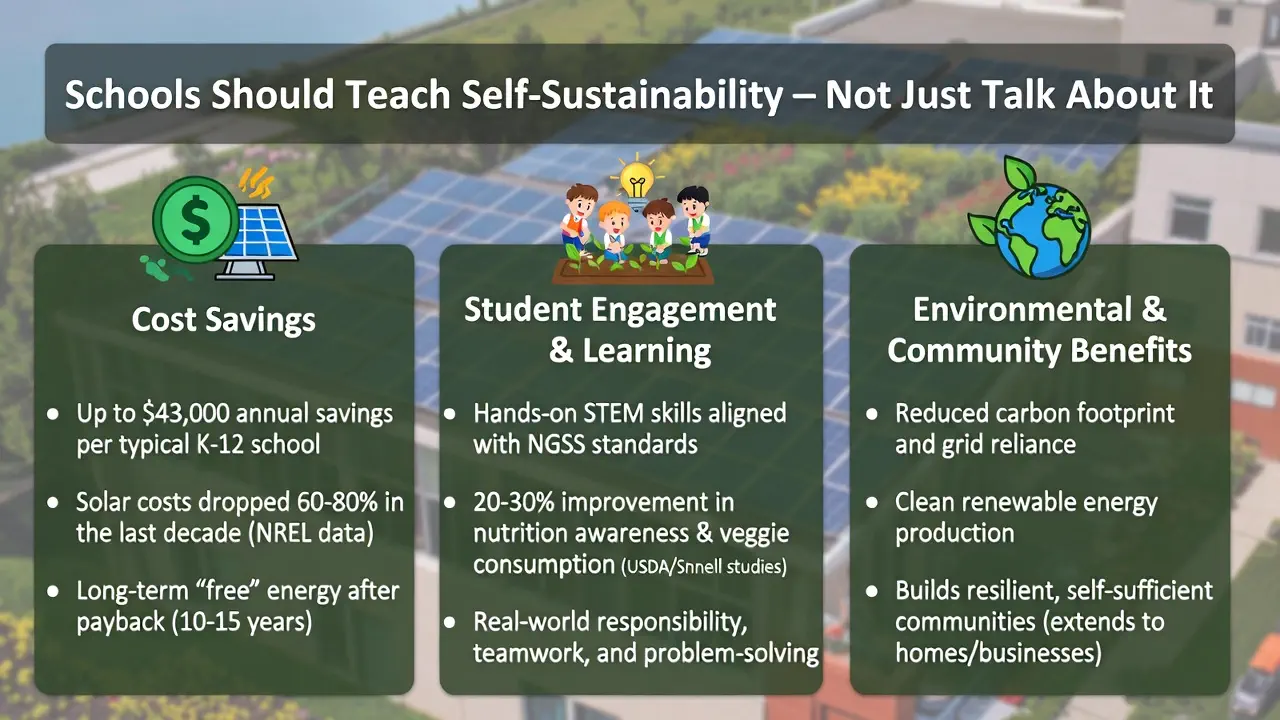
To me, schools are the perfect starting point for sustainability. They consume massive amounts of energy every day and serve as the foundation for future generations. Installing solar panels on rooftops isn’t just about clean energy — it’s about long-term cost savings and teaching students real-world skills. Every dollar saved on electricity is a dollar that can be reinvested into classrooms, programs, or maintenance.
At the same time, schools could be actively cultivating gardens that feed students, generate revenue, and teach essential life skills. This isn’t a symbolic gesture; it’s practical education. Students gain hands-on experience growing crops, understanding nutrition, and learning how to manage a small-scale food system — skills that will benefit them far beyond graduation. These programs align perfectly with educational standards like the Next Generation Science Standards (NGSS), turning abstract STEM lessons into tangible projects that boost engagement and retention.
Solar Technology Is Becoming Far More Efficient and Affordable
Another reason sustainability should be prioritized now is that solar panels are far more efficient and affordable than ever before. Over the past decade, the cost of solar systems has dropped dramatically — residential, commercial, and utility-scale installations are now 60–80% cheaper than they were 10 years ago, according to the National Renewable Energy Laboratory (NREL) . Recent trends show module prices stabilizing around $0.09/Wdc in early 2025, per NREL’s Spring 2025 Solar Industry Update .
At the same time, modern panels are significantly more efficient, converting more sunlight into electricity while requiring fewer modules to produce the same output. Innovations like perovskite tandem solar cells are pushing efficiencies toward 25-30% in lab settings, with commercial panels from leaders like Aiko Solar reaching up to 25.2% in 2025 models . These improvements make solar a realistic investment for schools — not a luxury. In fact, over 9,000 U.S. K-12 schools now have solar installations, serving more than 6.5 million students—nearly double the number from five years ago, as reported in Generation180’s 2024/2025 “Brighter Future” report .
Take the Los Angeles Unified School District (LAUSD): They’ve installed solar on 68 schools, generating 21.3 MW of power and saving an estimated $27 million over five years . Denver Public Schools have seen dramatic reductions in energy bills through rooftop solar, especially during peak usage times . And schools like Annie E. Fales Elementary in Massachusetts have achieved net-positive energy status with solar combined with geothermal systems, producing more energy than they consume . On average, a typical K-12 school can save about $43,000 annually with solar, based on various district reports .
Implementing rooftop systems today can reduce energy bills, pay for themselves faster, and provide students with a direct, hands-on education in renewable energy.
Helpful Resources on Solar Costs and Efficiency:
- National Renewable Energy Laboratory — Solar Cost Declines
- Residential Solar Price Drops
- Efficiency Improvements and Cost Reduction
- Recent Advances in Solar Panel Technology
Overcoming Barriers to Implementation
I know upfront costs and regulations can seem daunting, but in my experience, these are surmountable with the right tools. Federal incentives like the Investment Tax Credit (ITC) extensions, power purchase agreements (PPAs) that require zero upfront costs through third-party ownership, and grants from programs like the EPA’s Clean School Bus initiative make solar payback periods often 10-15 years or less—with panels lasting 25+ years to provide “free” energy afterward. For gardens, starting small with raised beds or containers, and tapping into USDA guidance or local donations, keeps things affordable. These aren’t luxuries; they’re smart investments that yield savings and educational value.
Hands-On Learning: Students Managing Solar and Gardens
Sustainability shouldn’t be abstract — it should be an integral part of learning. Students can actively participate in monitoring solar production, understanding usage, and managing surplus energy. This builds energy literacy in ways textbooks never could.
The same goes for gardens. Students could plant, grow, and harvest vegetables, using the produce in school lunches while selling extra to support the garden and energy programs. According to USDA Farm to School resources, school gardens increase students’ preference for and consumption of fruits and vegetables, with studies showing 20-30% improvements in nutrition awareness and attitudes toward healthy foods (per Cornell University and NIH reviews) . Programs in places like Guam integrate gardens into the curriculum for local produce access, with many U.S. districts using the harvest in cafeterias or selling surplus to fund expansions.
This approach teaches planning, responsibility, teamwork, and resource management. It’s a closed-loop system: students feed themselves, learn from the process, and fund the very programs that give them these opportunities.
Creating a Self-Sustaining Ecosystem
Schools that operate this way don’t just save money — they teach independence and problem-solving. They model a practical approach to sustainability that could be applied to any institution. The technology exists, the gardens are feasible, and the educational benefits are enormous. What’s missing isn’t innovation, it’s policy support and the will to prioritize self-sufficiency over mere consumption.
Extending Self-Sustainability to Homes and Businesses
Scaling the Model: Rooftop Solar and Community Batteries
This model doesn’t need to stop at schools. Homes and businesses could adopt the same principles on a broader scale. Rooftop solar could power individual buildings first, with excess energy stored locally in community battery hubs. These storage facilities could release energy during peak demand, outages, or high-consumption periods, helping stabilize the local grid.
Benefits for Homes, Businesses, and the Grid
In this system, neighborhoods and business districts become contributors rather than just consumers. Schools could serve as anchor producers, generating steady energy while feeding surplus into local storage. Businesses gain predictable energy costs, homeowners gain independence and resilience, and the grid benefits from distributed, managed energy production.
This vision is realistic: solar technology, battery storage, and smart inverters are all proven. What’s needed now is coordination, policy, and a willingness to shift from a purely consumption-based model to one where communities produce, store, and manage their own energy.
Time to Act: Empowering Tomorrow’s Leaders Through Self-Sustainability
Right now, we’re paying endlessly into systems we don’t control while the ability to generate energy locally is underutilized. If we truly want students to understand sustainability, we need to let them live it — tending gardens, managing solar panels, and seeing the results of their work in meals, energy, and financial sustainability.
It’s entirely feasible to feed students from the school garden and sell surplus to sustain the program. It makes sense, yet it’s still rarely done. Policies need to catch up with common sense, and schools need to lead by example. If we take this step, we don’t just teach sustainability — we make it a reality that students experience every day, preparing them for a future where independence, responsibility, and real-world problem-solving are essential.
In my opinion, schools have the space, the students, and now the affordable technology to become models of self-sustainability. By prioritizing solar installations and productive gardens in modernization projects, we save money, reduce emissions, boost student engagement, and teach real independence. Imagine the legacy: a generation of young people empowered to build resilient communities, protect our planet, and innovate for a brighter world. This isn’t just about cutting costs—it’s about igniting hope and action for tomorrow. Policymakers, administrators, and communities: it’s time to demand these features in every school upgrade. Contact your local school board or representatives to advocate for grants that fund practical sustainability—not just talk about it.