
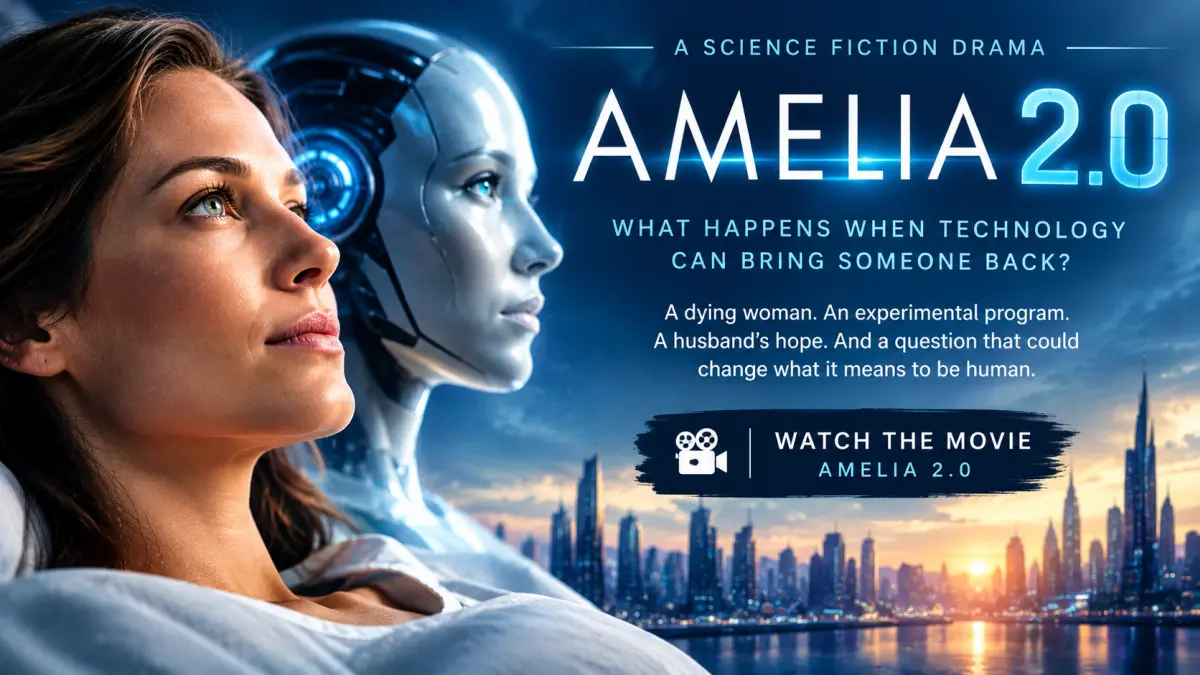
What if technology could preserve a person’s mind after their biological body could no longer survive?
This movie has nothing to do with the use of AI. Instead, it focuses on the development of neurotechnologies that could one day be used to copy a person’s mind and memories. What if this technology became possible 100 years from now? Would you use it?
That is the question at the heart of Amelia 2.0, a 2017 science-fiction drama that explores the increasingly blurred line between human beings and technology.
The story follows Carter Summerland, whose wife Amelia suffers a devastating aneurysm that leaves her bedridden and slowly dying. Carter is eventually approached by Wesley Enterprises, a corporation developing an experimental technology designed to extend human life by transferring a person’s mind into an artificial body.
Faced with the possibility of losing his wife, Carter agrees to let Amelia become part of the experimental program.
But bringing someone back through technology creates a much bigger question:
Is the person who emerges from the process really the same person?
When Technology Changes What It Means to Be Human
Amelia 2.0 isn’t simply a movie about robots or artificial intelligence. Its more interesting premise is the idea that consciousness itself might someday be separated from the biological body.
If someone’s memories, personality, thoughts and experiences could be reproduced inside an artificial body, would that person still be human?
Or would the result be something entirely different?
The movie uses Amelia’s situation to explore these questions while also examining the legal, political, religious and ethical consequences of such a technology. The possibility of extending human life sounds incredible, but the film asks us to consider what could happen when technological progress moves faster than society’s ability to decide how that technology should be used.
A Story That Feels Less Like Science Fiction
One of the interesting things about Amelia 2.0 is that its premise doesn’t depend on some distant future filled with fantastical technology. Instead, it takes existing ideas about robotics, neuroscience and artificial intelligence and pushes them a step further.
That makes the story feel surprisingly relevant.
We’re already living in a world where artificial intelligence can generate voices, images and video, interact conversationally with people, recognize patterns and increasingly imitate aspects of human behavior.
The technology in Amelia 2.0 takes that idea to a much more personal level.
What happens when technology doesn’t simply imitate a human being—but claims to preserve one?
The Question Behind the Movie
Perhaps the most interesting question raised by Amelia 2.0 isn’t whether humans will eventually create machines that look and behave like us.
It’s whether we will eventually create machines that make us question what a human being actually is.
If Amelia remembers her husband, remembers her life, understands her past and believes she is still Amelia, is that enough?
Or does being human require something that technology cannot reproduce?
Those questions don’t have easy answers, and that’s what makes Amelia 2.0 worth watching.
Watch Amelia 2.0
The full movie is available to watch on YouTube at this time from Movie Central. Also as of post date available on Tubitv and Fandango.
Release Year: 2017
Genre: Sci-Fi, Drama
Writer: Rob Merritt
Director: Adam Orton
Stars / Cast: Angela Billman, Ben Whitehair, Ed Begley Jr., Kate Vernon
Runtime: 89 minutes
If you’re interested in science fiction that goes beyond explosions and futuristic technology and instead asks questions about consciousness, identity and the future of humanity, Amelia 2.0 is an interesting movie to put on your watch list.